AIEEE Questions

Q:

Which of these molecules are polar? Check all that apply.

A) SO2 B) CH2Cl2
C) PCl3 D) All the above
 
Answer & Explanation Answer: D) All the above

Explanation:

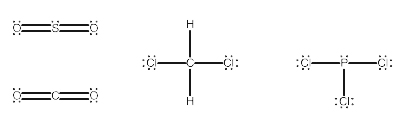
   1) SO2                  2) CH2Cl2                3) PCl3

polar1525846214.jpg image

How to check the given molecules are polar or non polar :

If the electronegativity of the two bonded atoms are different then the bond is polar. Although, some molecules contain polar bonds, the molecule may be non-polar. If the polarity of all the bonds present in the molecule are cancel each other then molecule is non-polar.


In the given options,

SO2  is polar because the dipole moments on the O do not cancel.

PCl3  is polar because the P-Cl bonds do not cancel out.

CH2Cl2  polar because the C-Cl bonds do not cancel.


Hence, in brief, Polar molecules are molecules with net dipole due to the presence of partial positive and partial negative charge.

For example, water is a polar molecule that has partial positive and partial negative charge on it. CO2 is a non polar compound.


Therefore, all the given options SO2, CH2Cl2 and PCl3 are Polar molecules.

Report Error

View Answer Report Error Discuss

Filed Under: Chemistry
Exam Prep: AIEEE , Bank Exams , GATE
Job Role: Analyst , Bank Clerk , Bank PO

5 10732
Q:

Arun and Varun started business in partnership investing Rs. 20,000 and Rs. 15,000 respectively. After six months, Akhil joined them with Rs. 20,000. What will be Varun's share in the total profit of Rs. 25,000 earned at the end of 2 years from the starting of the business ?

A) Rs. 7500 B) Rs. 4520
C) Rs. 8750 D) Rs. 6350
 
Answer & Explanation Answer: A) Rs. 7500

Explanation:

Arun : Varun : Akhil = (20000 x 24) : (15000 x 24) : (20000 x 18) = 4:3:3

B's share = 25000 x 3/10 = Rs. 7500.

Report Error

View Answer Report Error Discuss

Filed Under: Partnership
Exam Prep: AIEEE , Bank Exams , CAT , GATE
Job Role: Bank Clerk , Bank PO

5 10719
Q:

Which one of the following does not contain Silver ?

A) Horn Silver B) Ruby Silver
C) Lunar Caustic D) German Silver
 
Answer & Explanation Answer: D) German Silver

Explanation:
Report Error

View Answer Report Error Discuss

Filed Under: General Awareness
Exam Prep: AIEEE , Bank Exams , CAT
Job Role: Bank Clerk , Bank PO

30 10716
Q:

Which insect sits on uncovered food?

A) bees B) flies
C) Both A & B D) None of the above
 
Answer & Explanation Answer: C) Both A & B

Explanation:

Both flies and bees can sit on the uncovered food and contaminate the food.

Report Error

View Answer Report Error Discuss

Filed Under: General Science
Exam Prep: AIEEE , Bank Exams , CAT
Job Role: Analyst , Bank Clerk , Bank PO

16 10712
Q:

Where does the series number on a map appear?

A) Upper right margin B) Lower left margin
C) Both A & B D) Not Exist
 
Answer & Explanation Answer: C) Both A & B

Explanation:

The series number is found in both the upper right margin and the lower left margin. It is a sequence reference expressed either as a four-digit numeral (1125) or as a letter, followed by a three- or four-digit numeral (M661, T7110).

Report Error

View Answer Report Error Discuss

Filed Under: General Awareness
Exam Prep: AIEEE , Bank Exams , CAT
Job Role: Analyst , Bank Clerk , Bank PO

12 10711
Q:

A cuboid of dimension 24cm x 9cm x 8 cm is melted and smaller cubers are of side 3 cm is formed.find how many such cubes can be formed ?

A) 64 B) 56
C) 48 D) 40
 
Answer & Explanation Answer: A) 64

Explanation:

Volume of cuboid = (24 x 9 x 8) cm = 1728 cu.cm
Volume of small cube = (3 x 3 x 3) cm = 27 cu.cm


So, No. of small cubes formed = 1728/27 = 64.

Report Error

View Answer Report Error Discuss

Filed Under: Volume and Surface Area
Exam Prep: CAT , Bank Exams , AIEEE
Job Role: Bank PO , Bank Clerk

5 10709
Q:

A sum is divided among K, L and M in such a way that for each rupee K gets, L gets 45 paisa and M gets 30 paisa. If the share of L is Rs. 27,  what is the total amount  ?

A) Rs. 159 B) Rs. 96
C) Rs. 147 D) Rs. 105
 
Answer & Explanation Answer: D) Rs. 105

Explanation:

K : L : M = 100 : 45 : 30
              = 20 : 9 : 6

Given L share is 27

=> 9  ------  27
      35 ------  ?

      => 105

Report Error

View Answer Report Error Discuss

Filed Under: Ratios and Proportions
Exam Prep: AIEEE , Bank Exams , CAT , GATE , GRE
Job Role: Bank Clerk , Bank PO

11 10706
Q:

Bhim has assembled a basket of fruit as a holiday gift for each of his friends- Santosh, Tarun, Ujjwal, and Varun. A total of fifteen pieces of fruits-five apples, five oranges and five pears are distributed among the four baskets according to the following conditions: Santosh , Tarun and Ujjwal will each receive exactly two different types of fruit. Varun will receive only apples. Tarun will receive more pieces of fruit than Santosh. Each basket includes at least three pieces of fruit.

1. If Varun’s basket contains more pieces of fruit than Tarun’s basket, then Tarun’s basket must contain:
I. Four pieces of fruit.
II. At least one orange.
III. At least one pear.

(a) I only   (b) III only    (c) Botha I and II   (d) Both II and III


2. If Ujjwal’s basket contains more pieces of fruit than Tarun’s basket, all of the following must be false EXCEPT:

(a) Only Varun will receive apple

(b) Varun will receive exactly four apple.

(c) Ujjwal will receive exactly two apple.

(d) Tarun will receive exactly four pear.

Answer

1. Answer (b)


Santosh , Ujjwal and Varun must each receive at least three pieces, but Tarun must receive at least four pieces. The maximum number of pieces that any person may receive is six ( 6 + 3+ 3+3 = 15 ), and only Tarun may receive six pieces. Ujjwal and Varun each may receive as many as five pieces, while Santosh may receive only four pieces at maximum.
At least one pear.


2. Answer (c)


Varun may receive no more than five pieces and Tarun may receive no fewer than four pieces. As a result, if Varun receives more pieces than Tarun, then Varun must receive five pieces, and Tarun must receive four pieces. Thus, statement (a) must be true. Since Varun will receive five pieces, none of the other three friends will receive any apple, accordingly, each of the other three friends must receive at least one orange and at least one pear. Thus, statement (b) and (d) must be true.

Report Error

View answer Workspace Report Error Discuss

10 10701